
Brain-Based Education and Educational Zigzagging
The importance of early education is supported by many research studies and many educators. How to deliver early education to young children and take full advantage of the opportunities to wire the brain is not so well defined. Development of a program to instruct young children must include experts in early childhood education who have focused their research on how the brain learns. Research is the basis for the FasTracKids® signature curriculum and it determined how the early childhood education program was constructed.
The following are some facts that we do know about brain development: |
 Neurological Research
- Heredity provides 30% to 60% of the brain’s wiring, while the child’s environment provides 40% to 70% of the brain’s wiring.
- Brain plasticity is defined as the brain’s ability to process the stimulation that it receives, growing more connections and developing a more efficient and faster processing brain.
- The brain changes through the process of making connections, not arriving at answers or solutions.
- Environmental stimulation can impact the IQ of a child by 20 points…either up or down.
- The school aged brain almost glows with energy consumption, burning 225% more glucose than the brain of an adult.
- The brain learns fastest and easiest during the early education years.
- By age five, 50% of the brain’s learning capacity has been wired. By age eight, 80% of the brain’s learning capacity has been wired.
- Circuits in different regions of the brain mature at different times, creating a window of opportunity.
*These facts are found in The Learning Revolution by Gordon Dryden and Jeannette Vos, and Teaching With the Brain in Mind by Eric Jensen
How Brain-Based Education is used in the FasTracKids Programs
The uniqueness of children’s minds creates a special challenge for FasTracKids instructors. Brain changes are still noticeable 48 hours after stimulation to the brain occurs. Many of these changes are significant to and predictive of the child’s future learning. In studying the brain, we have learned that the areas developed depend on the type of stimulation received.
FasTracKids students are exposed to complex activities to exercise and form brain connections. These activities must be presented in a fun, challenging way to insure that the children are engaged. They are further enhanced when they are accompanied by continuous feedback from instructors and peers.
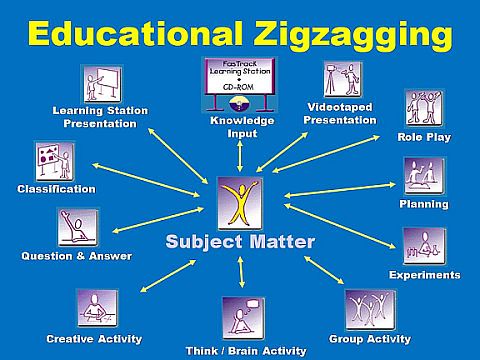
FasTracKids utilizes Educational Zigzagging methods that promote repetition without repeating the same piece of information in the same way. The content of the FasTracKids program is combined with the unique delivery of the lesson to form the key ingredients for growing young minds. The subject matter is continually reinforced through new activities using different modalities throughout the lesson to strengthen the children’s neural connections, without the typical loss of interest.
Educational Zigzagging refers to the learning of a concept by reinforcement of the subject matter through the use of many different exposures and applications. In a FasTracKids lesson, the concept to be learned is the center focus and is presented on the FasTrack Learning Station®. After each exposure to the concepts, activities are planned to strengthen the learning of the concepts. This includes learning through hand-on projects, experiments, role-plays and videotaping. The return after each activity to concepts presented by the lesson results in a zigzagging effect.